Operation Reach B.L.A.C.K. is a Pan-African Blog with an acronym that stands for Building Leadership Awareness and Cultural Knowledge.
The goal of this blog is to become a "Blog of Black Thought" focusing on matters of social, economic and political awareness through education (re-education), self-affirmation and cultural expression. Above all, this blog will DEMAND respect and appreciation for one another as black men and women.
Got something to say? Feel free to visit and comment on past posts. You can also email this site at opreachblack@gmail.comand follow on Twitter @reachblack.
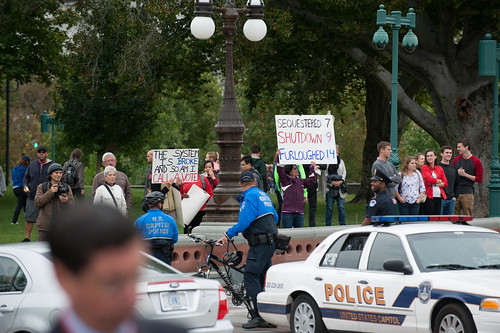
Once upon a time, before witnessing the
shutdown and near default of these United States, our federal government
was controlled by Democrats. But, as is often the case with life and
particularly true in politics, all that seems too good to be true is, in
fact, too good to be true. For though the White House and both houses
of Congresses were technically ruled by team blue, one pesky little fact
remained: the Senate filibuster.
A nation enthused
from an historic election that brought a wave of Democratic "control" to
Washington soon grew weary of the less than perfect results of
governing. And nowhere was this more clear than on the issue of health
care. There is no need to rehash the health care debate. Yes, if one
lesson is learned from this shutdown debacle, please let it be an
understanding that there is no need to rehash the health care debate.
But, if we only knew then what we know now, perhaps our lives would be
so much easier.
What we know now is that inferior
politicians don't create inferior policy. On the contrary, the role of
an inferior politician is not to propose inadequate government, rather
it's to do away with government all together. So, when a Tea Party
candidate says they want to shrink the size of government, you'd best
believe that what they really want to do is kill the whole thing.
And when such promises are made amidst a sea of snarling, low
information, low patience voters, the proper response is not to dwell on
the eccentricities of a political movement's penchant for
revolutionary-era garb, but to stop them before they get their hands on power.
America
had it's chance to stop them in 2010. We had a midterm election. Yes,
hindsight is 20/20, but a blind man could have seen the stupidity long
before the first ballot was ever cast. The vote is a sacred act, but
it's omission can hold consequences that are just as powerful. There is
no reason to be surprised by the chaos that has characterized our
legislative process for the past three years. And therein lies the
problem. When you think of D.C. dysfunction, ask how the Tea Party
gained so much power. And when you answer that question look towards
those who were both present and absent on that first Tuesday in November 2010. Voting is a right. However, not voting is a privilege far too many of us can't afford.
Rule
number one in politics is that elections are a zero-sum game. Perhaps
that sounds a little harsh. In theory, there shouldn't be any need for
such a narrow approach to government, however elections are very simple.
. . there is a winner, and there is a loser. That's rule-damn-one.
When all the votes are counted, are you up or are you down? The goal is,
not only to win a spot at the table of power, but to make sure that
your opponent doesn't get a seat of his own.
Democrats
held a lot of seats in the first year and a half of President Obama's
term, but not enough. Oh, so close, yet so far away, the crazy world of
Senate procedure decreed that a simple majority (something Democrats
did have) was insufficient whereas a supermajority of sixty (something
for which Democrats were practically several votes shy) could break a
filibuster.
When all was perfect with the world,
Democrats had sixty votes. But when is anything ever perfect?
Especially when vote number sixty was a conservaDem turned independent
who endorsed the eventual 2008 Republican nominee for president. Especially when several more votes were senators
whose very survival depended on navigating a sea of conservative voters
that despised the president before he even stepped foot in the oval
office.
Rule number two of politics is that results
matter. Tomorrow is never promised when it comes to the power grab, so
you'd better make the best of your time while you have it.
Unfortunately, that leads to rule number three: it's prose, not poetry.
Theory alone can be a luxury of those with too much time and too little
responsibility. Thus rules two and three mean that the practice of
governing requires a pragmatism that is focused on getting what you can
when you can get it.
We couldn't fight the good fight for single payer, political capital is fleeting. We couldn't have a public option because we didn't have the votes to break a filibuster.
Yet, these two very real pieces to the puzzle meant absolutely nothing
to a world driven by sensationalism and the 24-hour news cycle.
Remember, it's prose, not poetry.
So disappointment
commenced. And with that disappointment came resentment. And with that
resentment came shortsightedness. . . just in time for the midterm
elections.
A
self-fulfilling prophecy? The natural result of cyclical elections?
Who knows, but the results were clear. Bye-bye Speaker Pelosi, hello
Speaker Boehner. See ya later Democratic control, hello GOP chaos.
Forget the filibuster, now Republicans controlled an entire House to
obstruct the president's every move.
Congratulations, you just lost the House.
Congratulations, you have an even smaller, razor-thin majority in the Senate.
Congratulations, you did this in a year when the victor gets to redraw districts on a state level.
Your reward, you get to play prevent defense for the foreseeable future.
Democratic voters left the gate open in 2010. What will they do in 2014? What will the Tea Party do if given the chance?
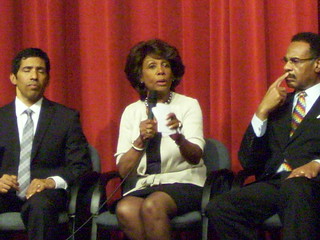
It seemed as though the former head of the Congressional Black Caucus, Representative Maxine Waters, rushed to the nearest television camera she could find. What was so important? Apparently, Ms. Waters was concerned about the use of "curious" language.
Of course, the story does not end there - though, perhaps Ms. Waters and the CBC could have saved face if it did. For at least then it would have been possible for the casual viewer to mistake Ms. Waters' campaign against "curious" language as a pushback against something a little more important than bedroom slippers - yes . . . bedroom slippers.
The slippers discussion was made during an MSNBC interview (here), but you can see the video of Representative Waters' CBS interview, here.
If Ms. Waters ended her thought at some nebulous precaution against "curious" language, perhaps a person watching his or her morning news program would have assumed she was speaking out against the "curious" words of the Republican presidential candidates. A viewer might have thought she was speaking of a GOP hopeful who seems comfortable with letting a man die for lack of health insurance, or even the "curious" behavior of a partisan GOP debate crowd that cheers executions and boos a member of our armed forces who happens to be gay.
Unfortunately, for Ms. Waters and the CBC, there's a long list of worthier topics to be concerned with before even beginning to think about the how the president chose to deliver his address last Saturday. If Ms. Waters' penchant for finding the microphone resulted in more talk about the American Jobs Act and less scrutiny over every syllable of President Obama's speech, maybe her recent television campaign would not have proven so petty.
But, make no mistake about it, this contrived debate over bedroom slippers and the president's alleged tone at a CBC event is just that . . . petty.
The contrasts could not have been clearer. A day after eight GOP presidential hopefuls took the stage in Wednesday's Republican debate, President Obama had his turn to address the American people. Long story short, the President delivered twice the leadership of his GOP rivals in half the time. And in doing so, perhaps the President reminded America of what sets him apart from most others in Washington. In a world of political calculations and gamesmanship, the President still puts the people first.
While the GOP spent Wednesday night rehashing its talking points and constructing an alternate universe for a partisan crowd at the Reagan Presidential Library, President Obama spoke to America - Democrats, Republicans, and Independents - in the self-proclaimed "People's House" of Congress. It is a move that does not get enough credit in today's cynical political environment. This was not a "play it safe" kind of moment. Unlike those eight Republicans, the President did not speak in front of a friendly audience. Quite the contrary, speaking in the House of Representatives was more of an away game for a man who has seen Congress attempt to block his every move.
Far from a partisan crowd, the President practically stepped into the belly of the beast. The 2010 Elections still fresh in memory, Republican Tea-Party members ever so prominent, President Obama could have settled for the friendly confines of his Oval Office. But he did not. A speech of this magnitude for a problem this big could not be confined to the four walls of the White House. No, putting the people first required that the President speak in the "People's House."
The President could not rely on cheap applause from a room that was majority Republican. Indeed, certain lines dealing with tax cuts for the wealthy received outright derision from the Republican side of the aisle. Other proposals for matters such as infrastructure and labor rights were met with stone faces. But this speech wasn't for the suits in peanut gallery so much as it was a message for the millions of Americans watching on television. President Obama's message: Despite all of the craziness you see around me, I stand with you.
Nor was it sufficient for the President to toe his own party line . . . or perhaps, better put, "line in the sand." Surely some will protest that President Obama's speech was not the red meat, "base" fodder that progressive Democrats demanded. The President did not attempt to lay all of the blame at the Republicans feet (although it would have been warranted). Neither did President Obama use his prime-time appearance to present a wish-list of every Democratic platform that had absolutely no chance of passing Congress. However, in the spirit of leadership that makes this man exactly who he is, the President carved a path through pragmatic determinism that is all too lacking from our political officials.
Others would more correctly note that, despite its bipartisan appeal, there was plenty of red meat for the base to chew on. However, as suggested by some reactions, the "red meat" was not meant to define the speech. And probably by design. In the aftermath of the President's address, MSNBC's Chris Matthews marveled at the fact that President Obama talked infrastructure without really uttering the word "infrastructure." President Obama talked stimulus without falling prey to the word police of a media trained to see "stimulus" as a dirty word.
And still, President Obama succeeded in presenting a Democratic vision for the future that is likely more persuasive than had he pounded his fist and pointed fingers. The President stood up for workers rights, used many of the GOP's arguments against itself, and gave an impassioned defense for the role of government.
But still, President Obama defined the night by doing what so many regardless of party fail to do. He led.
The President did not fall back on the soundbite culture of a 24-hour news cycle. Certain critics from the Left demanded he "take it to the Republicans" or present a bill for the sake of politics alone. Instead, President Obama presented a bill that it seems he felt could actually get by Congress. And in addition to this welcomed pragmatism, President Obama vowed to take the American Jobs Act around the country to the American people. The Pyrrhic victory of tone over substance may be unavoidable. But rather than take cover behind the constant partisan back-and-forth, the President made it clear: He'll do what's necessary, but he'd rather spend his time working.
In other words . . . President Obama did NOT take the easy way out.
Oh, how easy it would have been to give a partisan speech, throw up his hands in disgust and say "See 'ya at the ballot box next November." But the President did not do that. Why? Well, in the President's own words from Thursday's speech. . .
"This past week, reporters have been asking, 'What will this speech mean for the President? What will it mean for Congress? How will it affect their polls, and the next election? But the millions of Americans who are watching right now, they don't care about politics. They have real life concerns. (emphasis added)
Bingo.
Some get it, many more do not. There is a time and place for politics. But, more importantly, there is a time and place for governance. Most politicians understand the former all too well. It is the latter where so many are lost. President Obama made it clear, he will campaign hard, but he will campaign with a purpose. The opportunity is there. Congress has a chance to accept the President's challenge to govern. The question is: Will they take it?
The fact is, we live in an environment with a 24-hour cable news cycle. We have to fill that time somehow. Too often, mainstream media chooses to fill that space with the hot air of partisan bickering. It perpetuates that space through false equivalency and petty controversies. This unhealthy mindset that politics is a game and "principle" trumps results, forgets the fact that real people's lives are at stake. It produces gridlock and feeds the cynicism that exists throughout our political discourse. Thankfully, we have a President that does not fall victim to this approach.
The issue is not whether President Obama will have to embark on a partisan campaign on behalf of the American people. The reality of an obstructionist GOP in a do-nothing Congress makes the President's campaign a near certainty.
But, stop for one moment to appreciate what transpired Thursday night. President Obama presented a strong and rational jobs plan that correctly anticipates the political realities of a divided Washington. Keeping with his pragmatic approach to leadership, the President will attempt to achieve what he can, when he can for the American people.
But frustration over the stalemate in our nation's capitol will only come to an end when we, the American voters, make the conscious decision to end the gridlock. It will come to an end when voters decidedly give a President enough votes in Congress to defeat the obstructionists. Not a moment sooner. That's the question for 2012: Who wants it?
But that's NOT the question now. The question for right now is simple: What can Washington do? It is not as sexy a question, but it is the question nonetheless. And fortunately we have a President who is willing to forsake the easy political points in his attempt to actually try and tackle that question.
We may look towards 2012. But, in the meantime? Well, in the meantime, we've got mouths to feed, mortgages to pay, and rent that's due. Bravado for a purpose, whether false or sincere, means nothing if the votes aren't there to pass it. Political pissing matches come and go, but the people continue to suffer.
Thankfully, our President understands this truth. Despite attacks from the Right AND Left, from figures with bigger mouths but lesser accomplishments, President Obama understands that the people come before politics.
As he said in his speech Thursday night,
"The next election is 14 months away. And the people who sent us here -- the people who hired us to work for them -- they don't have the luxury of waiting 14 months."
Translation: President Obama has decided that he will not waste your time. He chooses to work, instead.
That is admirable. Even more, that is exactly the kind of leadership we need as a country. Pardon, that is exactly the kind of leadership we have as a country. And perhaps voters will begin to realize this in time to turn their anger in the right direction as the spotlight shines brighter and brighter on those who choose to stand in the way of progress, and the lazy journalism that gives them cover. Contrary to the conventional wisdom of the pundit class, this President - President Obama - is NOT your problem.
Consider that the next time you see a Republican obstruct progress on the grounds of "principle." Consider that the next time you hear a Democrat offer the moon without a plan (or the votes) to get there. The symbolic politics of the perpetual beltway shouting match is nothing new, and has yielded few tangible results.
This does not mean that we lower our sites from grander expectations, or bottle our passions. Even with this new jobs proposal, people will ask question. But it does mean that there is a value to that which is possible. And, in a world that cherishes the false bravado of career politicians who promise everything except that which they can actually deliver, maybe it is time we as a country begin to appreciate the sincere actions of modest politicians who work to get what they can. . . those politicians who put the people first.
When discussing birtherism, when can we call racism, racism? When is it ok?
Well, let's just ask The Daily Show. According to them, birtherism has more to do with scaring old people than painting a Black President as the perpetual "other" and denying him the place of his birth.
On Thursday, The Daily Show tackled the birther issue for the second night in a row. And when the topic of racism came into play, host Jon Stewart turned towards his trusty "Senior Black Correspondent," Larry Wilmore, to make sense of it all.
Wilmore's thesis: It's not racism, it's opportunism.
The sketch proceeds to suggest that the birther movement isn't about bigotry. No, instead it's about seizing the opportunity to scare old people. Respectfully, this premise misses the mark when discussing race and politics.
Implicit in all of this is a familiar argument that often comes from Democratic and Liberal circles when denying issues of race and this President. The dodge I speak of is the claim that President Obama faces so much hostility, not because of race, but because he's a Democrat.
However, when you think about it, this argument runs the risk of legitimizing the hate speech we've seen over the past few years. It seeks to explain away this vitriol as being little more than disagreement based on policy (i.e., Democrat vs Republican, Liberal vs. Conservative). If it were only that innocent. Ironically, this approach holds similarities to the very type of it's not him, it's the policy excuse of convenience in conservative media. It's an excuse that often lacks consistency and credibility.
Wilmore's response to questions of racism: "Were you alive in the 90s?"
This question is a dodge. It seeks to draw parallels, using any similarity as a one-size-fits-all explanation for the hatred many have shown this President. It's almost as if to say, Hey, they gave Clinton hell and he was a white guy. Or, more cynically, it strikes me as saying Watch it, if it happened to the White man, you can't cry racism.
Sorry, but whether they intended it that way or not, I've got to give The Daily Show an "L" for this one.
Now, let me be clear. I understand that we are talking about social and political satire. It has not escaped me that these are comedians seeking to make light of a very dark subject. So my point is not to judge The Daily Show, Jon Stewart or Larry Wilmore as somehow defending birthers. I recognize that The Daily Show has done great work in the past, shedding light on a host of issues the mainstream media chooses to ignore. I get that.
To be truthful, if anything, this Daily Show sketch has served more as a springing board for this piece on race in politics than the actual target of my disdain. But still, satire or not, the sketch presumably seeks to make a point. And that point - opportunism over racism - is, in my opinion, a dodge we've seen far to often when it comes to race and politics.
To answer our "Black Correspondent's" question, yes, I was alive in the 90s. Admittedly, I was only beginning high school back in '95, but the 90s was a hotbed for racial and social unrest. And it was during this time when I, and presumably millions of other people my age, experienced our introductions into the political and social discourse.
And you know what I remember?
I remember a president who was the subject of many smears in his own right. But, with that being said, I also remember that, despite these smears, the Democratic Party (and yes, most progressives) had Clinton's back the entire time - which is more than I can say for the support shown for President Obama right now (just start at the 2008 primaries and work your way forward).
But, one thing I don't remember about the 90s is anyone asking to see President Clinton's birth certificate. And to the extent some fringe-type might have ever tried, I certainly don't remember a sustained cultural movement, legitimized by a mainstream media's undying infatuation with race-baitors.
There were accusations of unAmerican values back during the 1992 Presidential campaign. You can read more about this here: Anatomy of a Smear. But even those smears were levied at alleged activity by then candidate Clinton, not at some innate quality such as his birth.
And while we're at it, I also don't remember self-described revolutionaries armed with loaded assault rifles standing outside of presidential events. But, can we call that racism?
But, no need to go back to the 90s for race-baiting politics, does anyone remember 2008?
Because I remember a certain presidential candidate, her husband (you know, the former President), and surrogates employing some of the same psst. . . you know he's black, right? strategies that we see today.
You remember, don't you? It was something along the lines of . . .
Obama can't win the white vote.
Obama was raised in a Madrassa.
Of course Obama won South Carolina, look at Jesse Jackson.
Remember what happened to Robert Kennedy? (WTF???? I mean still, WTF)
That list goes on and on.
So no, the Clinton dodge does not apply. Not all political smears are created equal. Some things are best judged on their own merits.
So since the 90s doesn't work, it looks like we have to dig deep. . . real deep into our nation's history for even more false equivalency. Enter President Chester A. Arthur.
Really, now? Seriously? We gotta go all the way back to the 1800s for this?
The Daily Show noted that our 21st President faced a birther issue of his own. History shows President Arthur faced rumors that he was actually born in Canada. Crazy, huh?
But there are differences between Presidents Arthur and Obama that are worth noting. Mainly, as reported in an AP story two years ago, President Arthur never showed documentation of his birth when pressed to do so. Indeed, the AP story says that Arthur's home state, Vermont, didn't even keep track of such records until long after his birth.
On the contrary, President Obama has now revealed his birth certificate, not once, but twice. And yet, despite the overwhelming evidence, it's still not enough for his critics.
And why is this?
Well, black people have been screaming this for years.
uh hmm. . .
say it with me. . .
in unison. . .
sing it if you'd like. . .
It's not about the birth certificate.
It never was and never will be about the birth certificate. That's because it's about racism. That's,
R-A-C-I-S-M, racism.
And in a world where racism reinvents itself like a virus, we've traded in our blatant bigotry of generations gone by for a more subtle type of intolerance.
It is a type of racism that is flexible enough to fit a variety of boogeymen. Realize that our failure to deal with race in substantial terms, our nation's weak attempt to deodorize the funk of intolerance and hatred expressed through modern day politics, has yielded a foul fragrance. And this fragrance is only so useful as it successfully masks the even greater stench of our nation's dirty past. It is the "other." Our political "Secret" if you will. . . you know, strong enough for all minorities, but still made for "the Blacks".
So it should come as no surprise that even the most racist KKK member is not dumb enough to shout "NIGGER" when given the spotlight of prime time cable news. But he will go on and on about how the President isn't one of us. He'll go on and on about how we need to take our country back or how this President pals around with terrorists or doesn't see America the way you and I do.
And unlike President Bill Clinton, unlike President Chester A. Arthur, President Obama cannot escape his critics. For as the former saw politics as their tickets to hatred, the latter, our Black President, need no more than to show the color of his skin.
THAT is the difference.
President Clinton can and has traversed some of the most racist parts this country has to offer. And guess what. . . 15-20 years after his presidency, a noticeable amount of those good ole' boys are more than willing to let "Bubba" back into the pack.
It's different when discussing race.
So I guess I'll end where I began. I'll ask the same question: When can we call racism, racism?
We've made a lot of progress, but we've still got a long ways to go. If birtherism doesn't qualify as racism then tell me, what does?
There's been a lot of back and forth over the latest spat between Dr. Cornel West and Rev. Al Sharpton over the weekend.
Long story short, Dr. West challenged Rev. Al to be more critical of the Obama Administration, and even said he worried Sharpton might be manipulated by the White House (well, isn't that a tad passive aggressive).
But, this isn't about President Obama. This isn't about the plight of Black America, or speaking truth to power. No, on a basic level, this is about territory. In other words, who ranks where in the pecking order of "black leadership."
For his part, Rev. Sharpton stated what should've been obvious to everyone in the room, namely the fact that all of these problems (and you can make a long list) that impact the black community existed long before President Obama got into office. But what wasn't said is even more important. Not only have these problems existed before President Obama got into office, but they'll continue to exist long after he's gone. President Obama is not the issue. However, even more than territory, the real issue is the failure of black leadership to capture the enthusiasm of the 2008 Presidential Election to cultivate a sustained movement.
And therein lies the paradox.
If the purpose of the discussion is to teach the past. . . if the purpose is to inform the present, then Dr. West has a point. He articulated the vice that still grips the black community from the prison industrial complex to unemployment. He spoke with passion. There's just one problem with Dr. West's approach, however. The larger discussion of the status of Black America must be forward thinking.
Indeed, the focus of the MSNBC special was supposed to be the "black agenda." Thus, the title denotes some type of a plan. It implies a plan of action. . . note, I said "plan" and "action."
In the context of government a "plan" is most often associated with some type of legislative agenda, whilst "action" is best described as voting. Dr. West's problem in this clip is that, rather than act to enforce a plan, he simply restates the problem. He articulated the issues, but did not propose a solution. Instead, he acted as if the solutions are already there, but the President just doesn't want to act (this was a topic of discussion on a recent edition of "Blacking it Up" with Elon James White).
What good is it to regurgitate a laundry list of social ills without a realistic plan of action? Yes, President Obama could speak more about the prison industrial complex. The point being . . . ? I mean, by that logic, the President could speak more about teen pregnancy and HIV. The President could speak more about drug abuse and mental health. The President could speak more about a host of topics, not because he doesn't care, but simply because these problems exist. In other words, there will always be a market for complaints so long as social ills exist in our communities.
However, to imply a motive, to assume silence is acquiescence, is disingenuous. This President has chosen to tackle the large issues as best as he can. That he hasn't spent more time on the prison industrial complex cannot be attributed to indifference any more than one could argue that immigration reform has not been tackled because the President hates Mexicans. Maybe. . . just maybe there's only so much a President can do in his first term in office.
Therefore, the responsibility to lead on issues that are not at the forefront of the national dialogue rests with us. Yes, WE the people. Laying everything at the feet of the President is a cop-out. Again, restating the issue is not action.
So let's talk about action. "Action" as it relates to policy is all about votes. You either have the votes or you don't. In fact, it's really pointless to discuss policy without an honest assessment of the vote-count. So, for example, the public option sounds nice, but Democrats never had the votes. Critics from the Left refuse to acknowledge this point because it completely undercuts their argument. It completely dismisses their premise that the solutions would be realized but for an alleged lack of leadership by President Obama.
And this has been the dividing line amongst the Democratic Party since the beginning of President Obama's first term in office. Whereas the line of demarcation had been liberal vs. conservative, the dividing line now rests between theory and pragmatism. The division represents those who wish to build off of what can and has been done versus those who wallow in the pity of that which has not been accomplished.
To take a spiritual approach to the subject, it's the constant fight to resist the temptations of self-pity. It's been said that the devil makes you focus on what isn't, rather than work towards the possibility of what might be. Well, it's the same in politics. When you are tasked with the responsibility to create change, the easy way out is always the option to throw up one's hands in despair over what hasn't been accomplished. After all, it's much easier than working. . . note, I said "working,". . . towards the possible.
And Dr. West and the rest of Obama's critics from the Left will continue to fail in their arguments unless and until they come to grips with the realities of governing. It's a numbers game. Plain and simple. And, over the past few years, to continuously suggest that more progressive actions have not been taken for anything less than a lack of votes is . . . well. . . damn offensive. To claim some unsubstantiated insight into the man's innermost thoughts is a useless exercise. As much as some of us might wish otherwise, none of us are inside the President's head.
Trust me, a President Kucinich or President Howard Dean, would be stuck in the same predicament as President Obama. I don't care how much you use the bully pulpit, it won't make a Tea-Party Republican from a safe district, or a Conservadem from a red district change their votes. So you can either rejoice in the political theater that is the 24-hour news cycle or work to get what you can when you can get it. I choose the latter. I can not, and will not, put faith in a leader who won't settle for anything shy of that which he or she can not obtain. It makes no sense and I will not waste my time.
This constant and aggressive dismissal of any and all progress made under this President only works to demobilize the public. Focusing on what you don't have at the expense of what you have accomplished can never be a recipe for success. It's like smacking your momma for buying discount "Air Jacksons" from the shoe store when you asked for a pair of Air Jordans. Nevermind the fact that you didn't have shoes last week, it's the style that counts. Right?
Instead of coming up with a long term plan, a strategy to get those Jordans, you complain about the plight you're in. I mean, you could save your allowance. You could cut your neighbor's grass and save money that way. You could could hope they go on sale or put them on lay-away. But, rather than be proactive, you sit back and give a long dissertation on the state of wack sneakers. You hold your breath and stomp your feet. You demand a response - why didn't momma get me that $200 pair of sneakers? And when the answer is clear as day, you refuse to accept the obvious . . . she didn't have the money.
There is no conspiracy to deprive you of your right to floss in front of your friends on the first day of school. She's not begrudging you your swag. She just didn't have the money to buy the shoes you wanted. And to the extent that she did have a couple of extra dollars, forgive her if she used that capital to save some of the more basic needs that you already had - you know, like clean underwear and a fresh pack of tube socks.
Well, the answer to a lot of the Left's complaints is just as clear. . . we don't have the votes. We never had the votes in Congress to get everything we wanted, and the 2010 elections made things twice as hard. Did we come close to having the votes? Absolutely. But, close doesn't count. And when you have to rely on Conservadems from red states to enact progressive policies. . . well, we shouldn't be surprised that some hopes fall a little short.
And, as was the case with those Air Jordans you never got, the President and pragmatic liberals are not concerned with brand names and style points. We could care less about the pundit class and their constant bickering over subjects that have no purpose other than to fill a 24-hour news cycle. Nope, at the end of the day, we just want to make sure your feet are covered. We can always work to make things better so long as we fight to preserve what we have.
When the Tea-Party/Republicans hold an insurmountable vote lead in the House. . . when they have the power to "shut it down," you're damn right the President's going to make a compromise. He's going to save what he can while trying to avoid sacrificing the gains we've already made. It's that simple.
Dr. West is wrong because it appears he thinks we make progress by restating our plight. It's as if he thinks things haven't changed because people just don't know how bad it really is in the real world. It's an assumption that the masses are sleep-walking rather than down-trodden. It attributes our circumstances to a lack of fight, rather than a lack of resources. Sorry, but you don't need a PhD to graduate from the school of hard knocks. Life kicks your ass whether you choose to theorize the subject or not.
However, what we need is an ability to bring theory down to practice. We don't need lectures, we need ideas. We need policy ideas. . . strike that. . . we need pragmatic, realistic policy ideas that have the votes in Congress. And, to the extent that we don't have those votes, we need people like Dr. West to put their intellect to better use by galvanizing new voters and finding fresh candidates to run in the general and mid-term elections.
It's a daunting task. It's filled with anxiety and uncertainty. And like President Obama, you won't get credit for the good while you're blamed for the bad. Leadership is a thankless job. But, some of President Obama's more vocal critics should listen to what Rev. Sharpton had to say . . . "If you scared, say ya scared" and we can work from there. If you don't have the answers then say so. There's no crime in that. The offense comes when you attack the imperfections of other people's plans when you really don't have a plan of your own. So, say what you've got to say. Criticize if you must. After all, we might benefit from your ideas if you're willing to put them in action. But don't work to dismiss, ignore, or undermine the progress that has already been made.
And whatever you do, make sure you bring something to the table with you. Understand that what you want, and what you can get, ain't always the same thing. And learn to appreciate the first steps towards realizing the dream, however modest or trivial you might think they are. Above all else, please use your energy and effort to cultivate the ideas of your brothers and sisters rather than tear them down. If you've got the resources to help, say so. If you've got the experience to lead, show it. But do not . . . I repeat do not dismiss the actions of another just because you think they're imperfect.
Correct me if I'm wrong, but Rev. Al isn't stopping Cornel West, Tavis Smiley or anyone else from acting to better their communities. No one's been censored, in fact, Dr. West and Tavis Smiley seem to have no trouble accessing the microphone as frequently as Rev. Al. No one's stopping them.
So, someone please tell Dr. West that Rev. Al was right. Someone please tell him that the plight of Black America does not exist for lack of understanding the problems, but for lack of creating real-life solutions. They exist for lack of encouraging others to give their ideas. They exist because we've trivialized action to being no more than passion and a catch phrase.
And as for the main reason why Brotha West is wrong . . .
All of those problems. . . all of the social ills that he so eloquently ran off in his debate with Rev. Sharpton . . .
They'll still be there when President Obama finishes his second term in 2016. They will still be there. They were there before he arrived, and they'll be there after he's gone. You had bare feet before your Air Jacksons and you'll have bare feet after they've worn away. The challenge isn't understanding the plight, it's what are you going to do about it. What are WE going to do about it?
You may disagree with the approach. But, until you can come up with something better, don't step on someone else's shoes for trying.
President says Republicans would repeal Wall Street and Consumer Reforms
Less than two weeks before the 2010 elections President Obama warned that, if elected to power, Republicans would repeal certain laws focused on consumer protection and Wall Street Reform. Once again, the President used his weekly address to argue that we can't afford to take a step backward:
"Recently, one of the Republican leaders in the Senate said that, if Republicans take charge of Congress, repeal would be one of the first orders of business. And he joins the top Republican in the House, who actually called for the law to be repealed even before it passed.
I think that would be a terrible mistake. Our economy depends on a financial system in which everyone competes on a level playing field and everyone is held to the same rules - whether you're a big bank, a small business owner, or a family looking to buy a house or open a credit card. And as we saw, without sound oversight and common sense protections for consumers, the whole economy is put in jeopardy. That doesn't serve Main Street, that doesn't serve Wall Street; that doesn't serve anyone.
And that's why I think it's so important that we not take this country backward - that we don't go back to the broken system we had before. We've got to keep moving forward."
As for the threat to repeal Wall Street Reform, the President may have been referring to a PBS NewsHour interview done by Senator John Cornyn (R-TX) in late September of this year. Here is a video of that interview (question on repeal at around the 7 minute mark):
You can read the accompanying article at PBS' The Rundownhere.
DNC Chairman Tim Kaine responded to Senator Cornyn shortly thereafter.
"Yesterday, in an interview with the PBS News Hour, Senator John Cornyn, the chairman of the National Republican Senatorial Committee, declared his party's intent to "pretty quickly" undertake efforts to repeal Wall Street reform and health insurance reform if they win control of Congress. In response, DNC Chairman Tim Kaine issued the following statement:
'Senator Cornyn is not the first Republican to call for the repeal of Wall Street reform and health insurance reform, but I grow more concerned for our country's future every time I hear another Republican leader pledging to do away with critical legislation that guarantees, among other things, that American taxpayers will never again be left to bail big banks out of a mess that the banks created.
There is a rapidly growing rank of Republicans who show themselves to be hopelessly out of touch with middle-class Americans' concerns – for their families, their finances, and their future.'" (SOURCE Democratic National Committee)
 America
had it's chance to stop them in 2010. We had a midterm election. Yes,
hindsight is 20/20, but a blind man could have seen the stupidity long
before the first ballot was ever cast. The vote is a sacred act, but
it's omission can hold consequences that are just as powerful. There is
no reason to be surprised by the chaos that has characterized our
legislative process for the past three years. And therein lies the
problem. When you think of D.C. dysfunction, ask how the Tea Party
gained so much power. And when you answer that question look towards
those who were both present and absent on that first Tuesday in November 2010. Voting is a right. However, not voting is a privilege far too many of us can't afford.
America
had it's chance to stop them in 2010. We had a midterm election. Yes,
hindsight is 20/20, but a blind man could have seen the stupidity long
before the first ballot was ever cast. The vote is a sacred act, but
it's omission can hold consequences that are just as powerful. There is
no reason to be surprised by the chaos that has characterized our
legislative process for the past three years. And therein lies the
problem. When you think of D.C. dysfunction, ask how the Tea Party
gained so much power. And when you answer that question look towards
those who were both present and absent on that first Tuesday in November 2010. Voting is a right. However, not voting is a privilege far too many of us can't afford.